
The Ruth Collier Method
Think Clearly and Write Honestly

When I reflect on what shaped me most as a scholar, one seminar stands out: Ruth Collier’s dissertation writing workshop at Berkeley. Paul Pierson’s course on American Political Economy, co-instructed by Kathy Thelen, was also influential, but it was more thematic. In terms of how I think, write, and teach, Ruth had the greater impact on me. Though Ruth was technically semi-retired, she continued to teach this graduate seminar. Her influence was unmistakable. Her course was not heavily promoted, but everyone knew its reputation. If you were serious about writing a strong dissertation, you found your way into that room. Some students even came from other departments to take it.
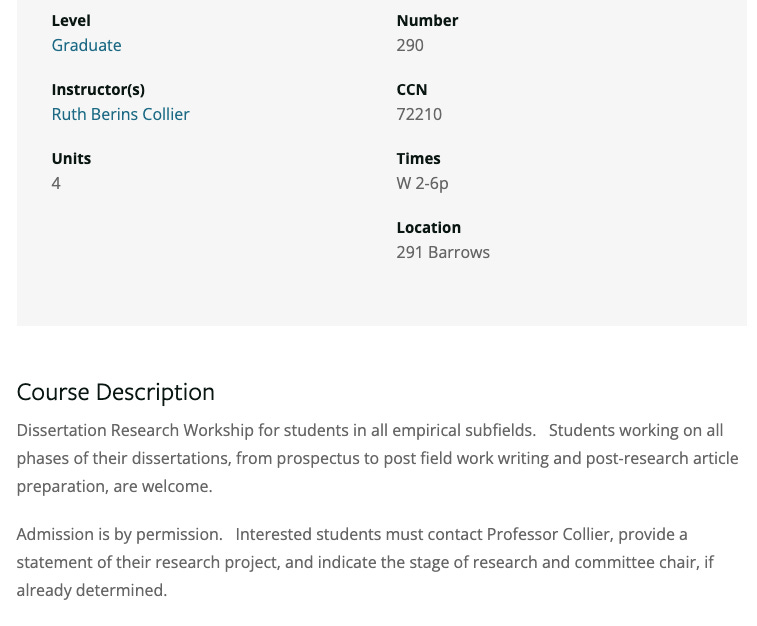
I took it twice: once early on, and again later in the dissertation writing stage. I wasn’t alone. Many of the best dissertations, award-winning papers, and eventual books passed through that seminar.
Among Berkeley political science alumni, there’s a quiet fan club of Ruth Collier. A few years ago, I co-organized a happy hour at APSA just so we could swap Ruth stories.
Ruth cared deeply about her students. She was kind, generous, and attentive in ways that mattered. Yet she did not let you off the hook. Each student was expected to present at least twice per semester. The presenter circulated a 5–6 page draft in advance, and everyone else came prepared to read it closely and provide comments. Ruth read everything, literally everything. She read every footnote and every endnote. She also told you, clearly and directly, when something did not make sense. You received the most honest and demanding feedback, along with clear-eyed and generous encouragement. She saw the potential in drafts you were ready to abandon and pushed you toward it, without letting you take shortcuts.
A good scholar, she modeled, must be curious, dedicated, and deeply caring for the craft. And as Rainer Maria Rilke once wrote in Letters to a Young Poet, she helped us go deeper within ourselves and find strength there we didn’t know we had. That’s what her push was for.
One of the most distinctive parts of her method was what happened when you couldn’t explain your idea clearly. If you were struggling -mumbling through a mechanism, circling around a concept - Ruth would stop you. “Go to the board,” she’d say. At least once per semester, each of us had to stand up and diagram our core argument. We then needed to draw a diagram and show how it worked. In private conversations in her office, she told me that she loved “grappling with ideas,” and it was her way of helping us do the same. It also served as a useful heuristic or criterion. If you could not diagram it, you did not yet understand it. The chalkboard exercise was uncomfortable, sometimes even humbling.1 It was also clarifying. It forced us to confront the fuzziness in our thinking. It sharpened our ideas and made our arguments more honest and more our own. It narrowed the distance between us and our ideas. The funny thing is that many of us, Ruth’s students, now use this method to mentor and teach our own students (including myself).
Over time, many of us developed what we jokingly called our “inner Ruth.” It was the voice that told us when a sentence was not clear enough, when a claim was not grounded, and when a paragraph was faking it. I do not know exactly how it happens, but the gift of her teaching is that even after the course ended, that voice did not go away. It became part of how we wrote and how we thought.
Ruth’s brilliance was not just in her intellectual depth, though she was one of the best comparativists, or political scientists, of her generation. She studied at least three world regions, Latin America, Africa, and Europe, and could move fluently between them. For many political scientists outside these regions, they may know Ruth through her work on historical legacies with her husband, David Collier, but her expertise is vast.
Her gift as a teacher was in how she trained us to think with precision and write with integrity. She helped us not only think clearly, but also write honestly. She asked us to be true to ourselves and tell the truth, in our own voices, to the audiences that mattered. She did not just teach us how to write better. She taught us to know what we were trying to say, and why. I remember telling her that I did not want to offend gatekeepers in the field while working with her in the workshop on the paper that eventually became my first academic publication. In response, she told me that if I believed what I wrote, I should go for it and own it.
In doing all this, Ruth created a space that was both rigorous and supportive, demanding and caring. It was a place where it was safe to take risks, and expected that you would. Her workshop trained us to write dissertations, yes. But it was more than that. It taught us how to do scholarship with clarity, honesty, and courage. Ruth changed our habits of mind and the way we tackle new problems. She also shaped how we educate and train the next generation of scholars.
Looking back, I have often wondered why her class was so influential. This is a frequent subject among students because taking the course with Ruth was such a transformative experience. In graduate school, you learn many things from many people, including advisors, instructors, peers, and others. Even so, it is not easy to find an intellectual role model. Ruth was that for me, and for many of us. Perhaps that is why I will not, and cannot, forget her lessons.
Ruth did not just tell us what scholarship should be. She showed us.
To be clear, while humiliating is negative, humbling is not a bad experience. It is learning.